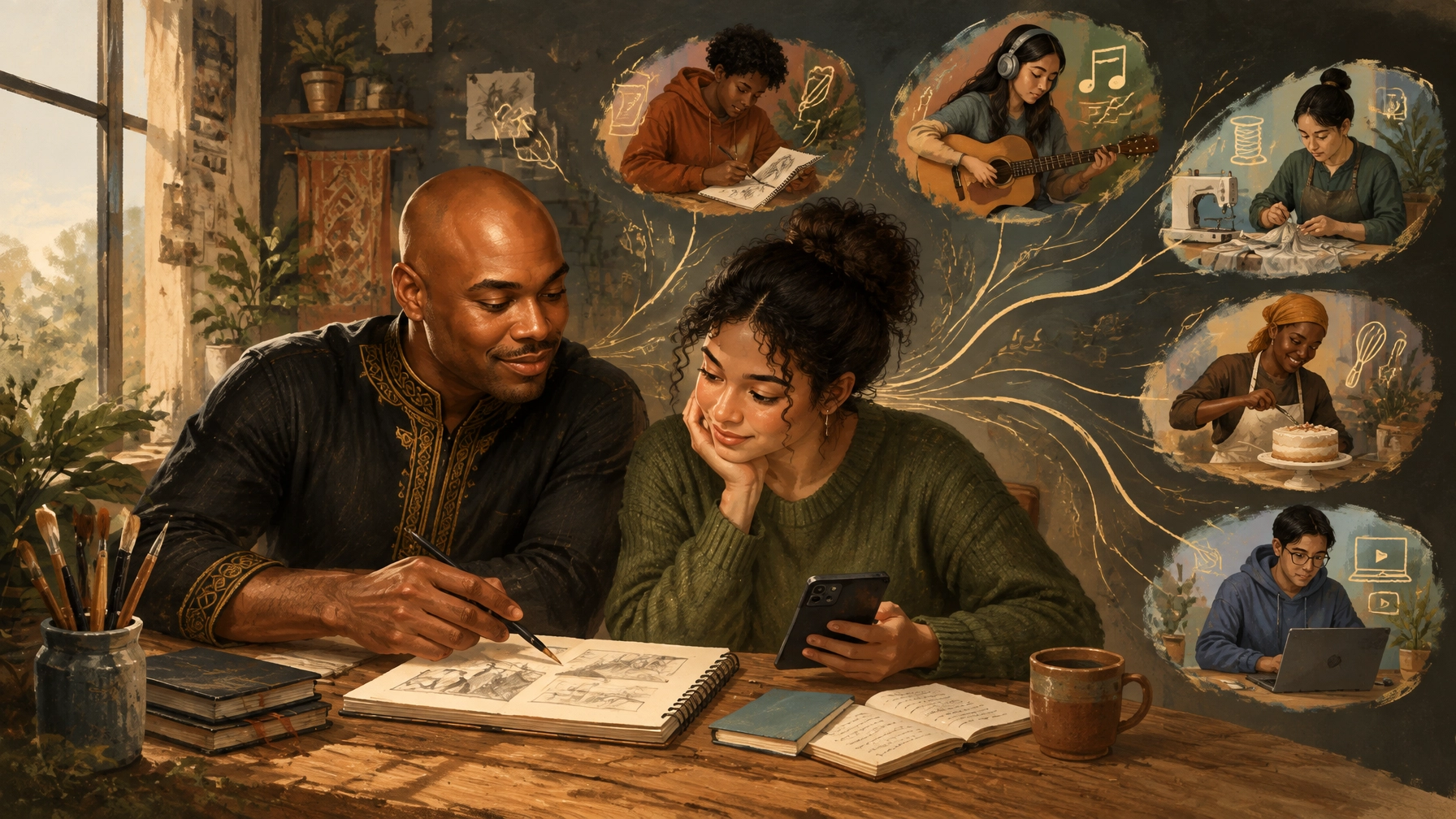
Most creators do not realize how much they already know.
A mother teaches herself how to photograph her children in better light. A baker learns how to make one reliable loaf of bread. A designer figures out how to create a clean logo. A musician learns to play a difficult song. A small business owner learns how to price, package, and deliver their work.
They may call these things hobbies, instincts, or simply “what I do.”
But these are skills. And skills become more valuable when they can be passed from one person to another.
Every creator has a first skill: the craft they practice and use to make something. Drawing. Writing. Photography. Music. Baking. Sewing. Coding. Building a business. Making videos. Solving problems.
The second skill is the ability to teach that first skill to someone else.
The second skill is the learned ability to make your knowledge clear, useful, and transferable so another person can use it for themselves.
This does not mean becoming a schoolteacher. It does not require a degree, a studio, a large audience, or a polished online course.
It means learning how to explain what you know, guide someone through a process, answer useful questions, and help another person take their next step.
Selling can support a creator. Teaching can extend one.
That difference matters for anyone thinking about creative income, digital skills, mentorship, and legacy.
Your first skill may be more valuable than you think
Creators often underestimate their own knowledge because their craft feels normal to them.
You may think, “Everyone knows how to do this.”
Usually, they do not.
You have simply spent more time noticing details, making mistakes, practicing, and developing judgment. You know what to do first. You know which shortcuts create problems. You can recognize when something is almost right but not quite there.
That knowledge is useful to someone who is just beginning.
A self-taught artist may believe their process is too simple to explain. A mother may not realize that other parents would benefit from her system for organizing creative work at home. A small business owner may overlook the lessons inside the way they handle customers, inventory, scheduling, or difficult decisions.
The first step toward the second skill is noticing what people already ask you.
They may ask:
- “How did you make that?”
- “What materials did you use?”
- “Can you show me how to do this?”
- “How do you get your photos to look like that?”
- “What should I do first?”
- “How did you learn?”
- “Can you look at mine and tell me what is missing?”
These questions are not interruptions to your creative work. They are clues.
They show you where your experience may become guidance for someone else.
Teaching is not a personality trait
Some people appear naturally comfortable explaining things. They speak clearly, tell good stories, and seem patient when someone is confused.
But teaching is not something reserved for naturally outgoing people.
Teaching is a skill you learn.
Good teaching involves several practical abilities:
- Breaking a large process into smaller steps
- Choosing language the learner can understand
- Showing examples instead of relying only on explanation
- Asking questions before offering answers
- Noticing where someone is stuck
- Giving feedback without taking away their ownership
- Adjusting your explanation when the first version does not work
These abilities improve with practice.
You do not need to become more entertaining. You need to become more observant.
A quiet person can teach beautifully. A person who dislikes being on camera can write clear guides, record audio, create diagrams, or help one person privately. A busy parent can teach one short lesson at a time.
The work is not to perform expertise. The work is to help another human being understand and act.
That is a different posture from guru culture.
A guru says, “I have the secret. Follow me.”
A mentor says, “Here is what I have learned. Let us examine it together, and you can decide how to use it.”
Teaching is stewardship. You are responsible for handling knowledge carefully, telling the truth about your experience, and helping people grow without making them dependent on you.
Why selling alone is fragile
Selling is not wrong. Creators should be paid for their work.
Artists need to sell artwork. Writers need to sell books. Designers need clients. Bakers need customers. Educators need sustainable income. Creative work cannot continue forever if it is never supported financially.
The problem begins when selling is the only relationship a creator knows how to build.
A creator who only sells is often dependent on:
- A platform’s algorithm
- A temporary trend
- A specific format
- Brand partnerships
- Constant visibility
- The ability to produce and promote without rest
- An audience that may not have a deeper connection to the work
This is tiring because every transaction begins again from zero.
When the platform changes, reach drops. When a trend fades, the offer becomes harder to notice. When attention moves elsewhere, the creator has to start shouting in a new place.
Research and industry reporting on the creator economy repeatedly show that income is uneven and often tied to platform-controlled visibility. The CreatorIQ State of Creators report and research on the platform economy both point to the instability that comes from depending too heavily on attention systems a creator does not control.
Teaching changes the relationship.
A sale gives someone a thing. Teaching gives someone a way to do something.
That does not make teaching automatically better than selling. It makes teaching a deeper form of value creation. A lesson can lead to a product, a service, a membership, a workshop, a book, or a community. More importantly, it can create trust based on usefulness rather than constant promotion.
Teaching grows your own craft
One of the quiet gifts of teaching is that it sends you back to your own foundation.
When you make something for yourself, you can rely on instinct. You can move through familiar steps without naming them. But when another person asks why you did something, you have to slow down and understand your own process.
You begin to see:
- Which steps are essential
- Which habits are personal preference
- Which principles apply across different situations
- Where beginners usually get confused
- Which parts of your method are still weak
- What you need to practice next
Teaching exposes gaps in your understanding without treating those gaps as shameful.
Research on learning by teaching has found that preparing to teach and actually explaining material can improve the teacher’s own memory, comprehension, and ability to apply what they know. Teaching requires retrieval, organization, and clear explanation. Those same activities strengthen your craft.
This is why a photographer who teaches composition often becomes more intentional behind the camera. A writer who teaches structure becomes more aware of the structure in their own work. A baker who explains fermentation learns to observe dough more carefully.
Teaching does not pull you away from your craft.
Done well, it helps you see your craft more clearly.
Teaching can strengthen selling, too
Teaching and selling are sometimes presented as opposites. They are not.
Teaching helps people understand whether your work is right for them. It also helps them understand what they need.
A short lesson can reveal a problem. A guide can offer a first solution. A workshop can help someone decide whether they need deeper support. A thoughtful explanation can show the care and judgment behind your paid work.
This creates a healthier path to creative income:
- Teach a principle
- Demonstrate a process
- Help someone make an early improvement
- Show what deeper practice involves
- Offer the next appropriate form of support
The key is that the teaching must be useful even before a purchase is made.
If every lesson is only a disguised sales pitch, people feel it. Teaching becomes manipulation when the creator withholds basic understanding simply to create dependence.
A steward does not hide the doorway. A steward helps people find the right doorway, even when the answer is not a purchase.
AI can remove the drudgery, but it cannot become the mentor
Artificial intelligence can make teaching more accessible for creators who have knowledge but not much time.
Used responsibly, AI can help you:
- Turn a rough idea into a lesson outline
- Break a process into beginner-friendly steps
- Create a first draft of a worksheet
- Suggest practice exercises
- Rewrite an explanation in simpler language
- Translate a lesson into another language
- Create multiple examples of the same concept
- Adapt a lesson for a child, beginner, or busy parent
- Generate questions that help learners reflect
- Organize notes from a voice recording into a guide
This matters because many people are not avoiding teaching because they lack something valuable. They are avoiding it because they imagine teaching requires hours of preparation and polished materials.
AI can help with the structure and repetition.
It should not replace your judgment.
You still need to decide whether the explanation is accurate, whether the examples are appropriate, and whether the lesson respects the learner. You need to notice where a person is discouraged or confused. You need to understand the context behind the question.
As UNESCO’s guidance on generative AI in education emphasizes, AI should support human agency rather than replace human responsibility. The same principle applies to independent creators.
Be honest about what AI did and did not do.
If AI helped organize your outline, say so when it matters. Check every factual claim. Do not present generated examples as personal experience if you have not lived them. Do not use AI to invent credentials, results, testimonials, or expertise.
AI can be your teaching assistant.
It cannot be the relationship.
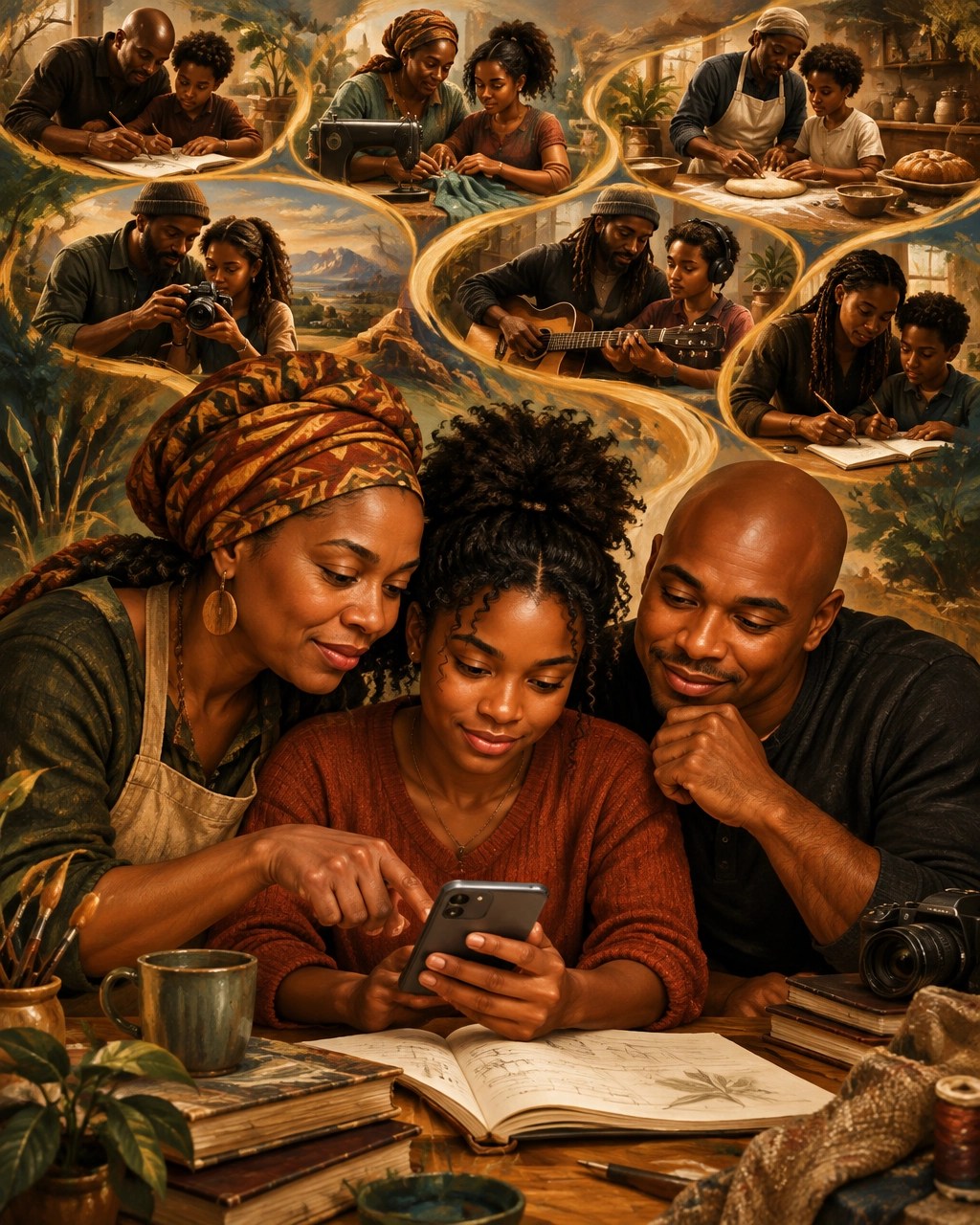
You can begin with a smartphone
You do not need a classroom to teach.
A smartphone can help you record a short explanation, photograph a process, answer a question, or share a simple demonstration. You can use a notes app to draft a guide. You can record an audio lesson while walking. You can hold a small video call with two people. You can send a voice message to someone who needs help.
This is especially important for people whose lives do not fit the traditional picture of an educator.
A mother can teach from lived practice
A mother may teach how to create art with limited supplies, organize a creative afternoon, encourage a child who feels discouraged, or build a family rhythm that leaves room for making.
She does not need to call herself an education expert. She can be truthful about what she has tried, what worked, what failed, and what she is still learning.
A small business owner can teach from responsibility
A shop owner may teach pricing basics, customer communication, product photography, bookkeeping habits, or how to recover from a mistake.
Their credibility does not come from pretending to know everything. It comes from explaining what they have actually practiced.
A self-taught artist can teach from the path they walked
A self-taught artist understands the confusion of beginning without a clear map. They can teach how to choose materials, build a practice, study references, or finish a first small project.
Formal credentials can matter in fields where safety, law, health, or professional licensing are involved. But in many creative areas, useful instruction can begin with honest experience and careful boundaries.
You do not have to claim more authority than you have.
You only need to share what you can responsibly stand behind.
The honest barriers to teaching
“I am not an expert yet.”
You may not be ready to teach everything. That does not mean you cannot teach one part.
Teach from the level you have earned. Say, “This is the process I use,” rather than presenting your method as the only correct one. Share what you know, name what you are still exploring, and point people toward deeper resources when needed.
There is strength in accurate limits.
“I do not want people to copy me.”
This fear deserves respect. Creative work can be personal, and copying can be harmful.
But teaching a principle is not the same as handing over your identity. You can explain how you think without giving away every original idea, client detail, or unfinished project. You can teach foundations while continuing to develop your own voice.
Your legacy is not protected by keeping every lesson hidden. It is strengthened when your work helps others develop their own distinct contribution.
“I do not have enough time.”
Do not begin with a full course.
Begin with a ten-minute lesson. Answer one question. Record one demonstration. Write one page. Make a checklist. Teach the part of the process that you can explain without creating a second full-time job.
Small lessons can become useful resources over time, but they do not need to become a large system immediately.
“I am not comfortable on camera.”
Camera teaching is only one format.
Write. Draw. Record audio. Use screen capture. Photograph your hands. Host a small conversation. Send a voice note. Make a simple slide deck. Let the format serve the learner and the lesson.
The goal is understanding, not performance.
Teaching does not require a full course
The internet has trained many creators to think teaching means building a large course with modules, a sales page, a launch sequence, and hours of video.
That is one form of teaching. It is not the starting point.
Teaching can be:
- One answer to one sincere question
- One short demonstration
- One annotated photograph
- One useful checklist
- One honest critique
- One voice message
- One small group conversation
- One guide that helps someone avoid a common mistake
- One example of how you made a decision
A lesson becomes meaningful when it helps another person move.
Do not measure the value of teaching only by its size. A small explanation at the right moment can change someone’s direction.
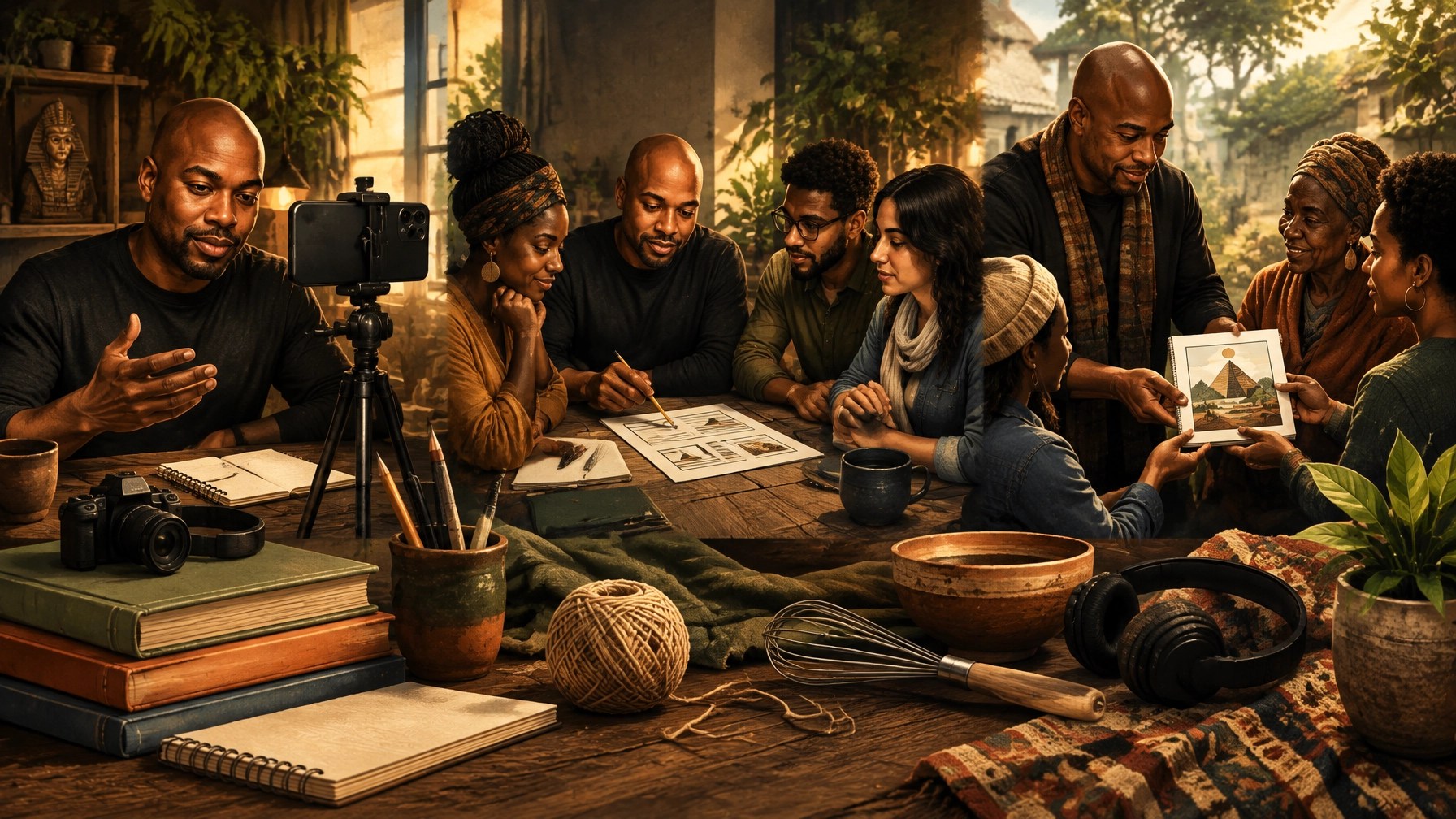
A simple progression for developing your second skill
The following progression keeps teaching human-sized.
1. Teach one person
Start with someone who has asked for help.
Listen to their actual question. Do not give them everything you know. Help them with the next useful step. Notice the words they use, where they hesitate, and what they understand quickly.
This is where you begin learning to teach.
2. Teach one small group
Invite two or three people to work through the same idea together.
A small group teaches you how to manage different questions and different levels of experience. It also shows you which parts of your explanation are clear and which need work.
3. Package one lesson
Take what you taught and make it repeatable.
This could be a one-page PDF, a short video, an audio lesson, a worksheet, a live session, or a simple digital product. Give it a clear beginning, middle, and end.
A good first lesson answers three questions:
- What will the learner understand or do by the end?
- What are the few steps required?
- How can they practice without you standing beside them?
4. Let it repeat
Share the lesson again. Improve it based on real questions. Translate it if that would make it more accessible. Create a beginner version or a deeper version.
Repetition is not a lack of creativity. It is how a lesson becomes dependable.
At this stage, your teaching may support several forms of creative income: a guide, a workshop, a membership, a mentoring relationship, a book, or a community. The income is not the only measure of success, but sustainable income allows the teaching to continue.
This is the builder’s path: make something useful, test it with real people, improve it, and build a structure that can serve beyond one moment.

Teaching is how creative work becomes legacy
A product can sit on a shelf. A song can remain in a library. A painting can hang on a wall.
But when you teach, your work enters another person’s decisions.
They use what you showed them to make something you will never see. They solve a problem for their family. They encourage a child. They help a customer. They teach someone else.
This is the beginning of legacy.
Legacy is not only a name remembered. It is a capacity that continues.
The Artfather vision is connected to this kind of work: creative education, human potential, mentorship, the future belonging to builders, and stewardship across generations. The goal is not to create more people who imitate one personality. The goal is to help more people become capable, thoughtful builders in their own lives and communities.
That is also why the second skill matters in an age of AI.
As tools become more powerful, information becomes easier to generate. Judgment, taste, context, patience, and care become more important. People will still need someone who can help them understand what matters, what is true, what is appropriate, and what to do next.
The future will not belong only to those who make the fastest.
It will belong to those who can build, explain, guide, and steward what they make.
Frequently asked questions
What is the second skill for creators?
The second skill is the ability to teach your primary creative skill to another person. It includes explaining processes, answering questions, giving feedback, creating lessons, and helping learners become more capable on their own.
Do I need credentials to teach a creative skill?
Not always. You should have appropriate credentials for fields that require licensing or professional qualifications, especially health, safety, legal, or financial work. In many creative fields, however, you can teach from honest experience if you are clear about your scope, avoid exaggerated claims, and continue learning.
Is teaching better than selling creative work?
Teaching is not automatically better than selling. Selling allows creators to support their work. Teaching creates a deeper and more transferable form of value. The strongest creative practice may include both: paid products and services alongside useful education and mentorship.
How can I use AI to help me teach?
AI can help create lesson outlines, worksheets, practice questions, translations, and accessible versions of your ideas. You should review everything carefully, protect private information, verify claims, and remain responsible for the final lesson and the relationship with the learner.
What is the smallest way to begin teaching?
Answer one question that people regularly ask you. Record a short explanation, write a one-page guide, or demonstrate one step. Teaching does not require a full course or a large audience.
How does teaching improve my own creative work?
Teaching forces you to retrieve, organize, and explain what you know. It reveals gaps in your understanding, sharpens your judgment, and helps you see your creative process more clearly.
Your first teaching question
What is the one thing people always ask you to help them with?
Write the answer down.
Do not dismiss it because it feels easy to you. It may be easy because you have practiced it longer than someone else. That experience may be the beginning of your second skill.
Teach one person. Share one honest lesson. Let the work become useful beyond your own hands.
That is how a creator begins to build something that can outlast a feed, a trend, or even a single lifetime.
Leave a Reply